R ‘Ray’ Wang, founder of Constellation Research, has joined Varney & Co. We analyze AI data center spending, Nvidia’s revenue outlook, and the broader market impact across technologies.
Nvidia is reimagining the future of healthcare. artificial intelligence (AI) tools are transforming nearly every corner of the hospital.
of California-based chip manufacturer Kimberly Powell, Nvidia’s vice president of healthcare, said the company is partnering with companies to integrate AI across healthcare, developing technology to assist surgeons, analyze scans and save doctors hours of paperwork.
“We’re an AI and accelerated computing platform company,” Powell told FOX Business. “What we do is help other companies deliver AI solutions. for hospitals We have a lot going on ourselves and a lot of incredible opportunities. ”
NVIDIA leads America’s AI ‘industrial revolution’ with massive manufacturing move
The World Health Organization predicts a shortage of 11 million health workers by 2030, and Powell said AI will be essential to meeting growing demand.

Pictured is Kimberly Powell, vice president of healthcare at Nvidia. Powell said the California-based chipmaker is partnering with companies to integrate AI across healthcare. (NVIDIA)
“It is clear that the demand for medical services far exceeds the supply of medical professionals,” she said.
Nvidia is pushing deeper into “physical AI,” where AI takes physical embodiments such as: robot to help Powell said they need to deal with real-world tasks.
The tech giant is collaborating with GE HealthCare on autonomous X-ray and ultrasound capabilities to expand imaging access in underserved areas. We are also working with Moon Surgical, which has developed a robotic assistant that can adjust surgical cameras in real time.
“They can basically move the camera into view of where the surgeon is with the tools,” Powell said. “…This is the first time that AI actually moves a robot.”
NVIDIA is also working with Johnson & Johnson to create a virtual operating room environment that can “simulate how a robot will operate within a virtual world before it is deployed in the real world,” Powell said.
NVIDIA invests up to $100 billion in OPENAI

File photo: Photo of a nurse caring for a patient. The World Health Organization predicts a shortage of 11 million health workers by 2030, and Powell said AI will be essential to meeting growing demand. (license/image)
Delivery robots are also being used to transport supplies, she said, easing the burden on nurses.
Powell said NVIDIA’s technology extends beyond robotics to software that helps doctors avoid burnout.
Abridge has developed a voice app that records and transcribes conversations between doctors and patients, automatically creating medical notes.
“Instead of the doctor sitting there and typing, instead of making eye contact with you, all of that can be captured automatically,” Powell said. “…we are helping doctors create medical records, saving them about 30% of their day.”
OpenEvidence, calledMedical ChatGPT” aggregates medical research to help physicians answer clinical questions.
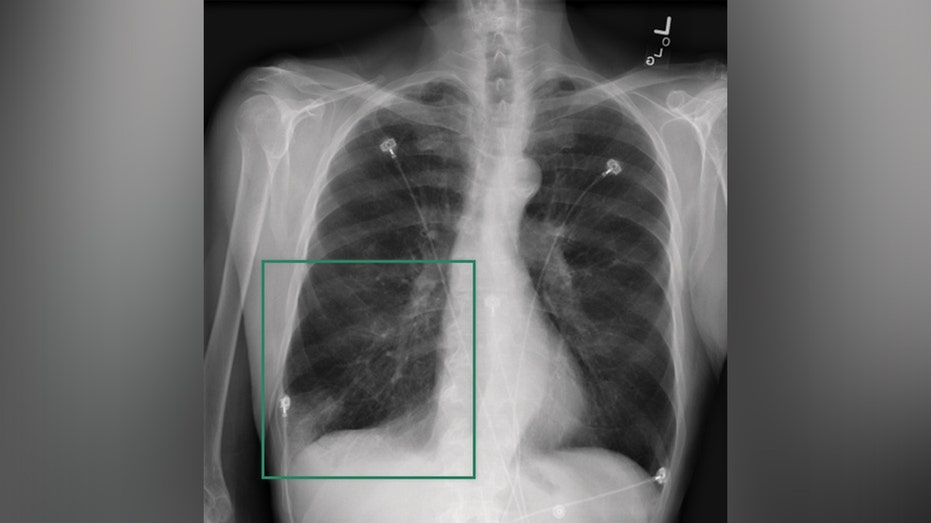
File photo: An X-ray is shown here. Aidoc can analyze radiology images to help detect strokes and other serious conditions. (NVIDIA)
China claims NVIDIA violated antitrust laws
Aidoc, on the other hand, analyzes radiology images to help detect strokes and other serious conditions faster.
“Every second a stroke actually causes more and more brain damage,” Powell said. “So these essentially visual agents can work in the background and go through all the images through the system and look for acute things like that, allowing us to triage patients more quickly.”
To address safety concerns, Powell said Nvidia and its partners are designing systems with multiple layers of guardrails.
“You could ask questions like, ‘Could you tell me if there’s anything abnormal about this X-ray?'” Powell said. “Then, the radiologist reads out the exact train of thought that you were taught in school.”
August 28, 2024 at Nvidia headquarters in Santa Clara, California. (Lauren Elliott/Bloomberg via Getty Images/Getty Images)
Looking ahead, Powell believes the hospital of the future will be an intelligent network of AI that senses, analyzes and automates operations in real time.
“Everything will be AI,” she says.
For those uncomfortable with the idea of AI in healthcare, Powell said the technology is meant to assist human experts, not replace them.
CLICK HERE TO GET FOX BUSINESS ON THE GO
“Human medical professionals are still being contacted,” she says. “For people who are feeling a little uncomfortable with the digital experience, I think they should see it as just a helping hand.”